


#15MinOfCHANGE: Small Conversations, Big Transformations
Sport in Europe is much more than competition—it’s a cornerstone of community life, social inclusion, and wellbeing. Grassroot sports clubs, often run by volunteers, bring people together across generations, promote physical activity, and address wider social challenges such as health, education, and sustainability.
Yet, in recent years, these clubs have faced mounting challenges. Declining memberships, difficulties in recruiting volunteers, digitalisation gaps, and the lingering effects of the COVID-19 pandemic have left many local organisations struggling to keep up. At the same time, society increasingly looks to sport as a solution to broader issues—whether it’s climate action, youth engagement, or social cohesion. This mismatch has created what researchers call a “gap” between expectations placed on grassroots sport and the resources clubs actually have.
This is where the CHANGE project, co-funded by the European Union, comes in. Coordinated by ENGSO and involving partners from nine European countries, CHANGE seeks to equip sport organisations and leaders with sustainable, innovative tools to bridge these gaps and strengthen grassroots sport for the future.
What the research reveals
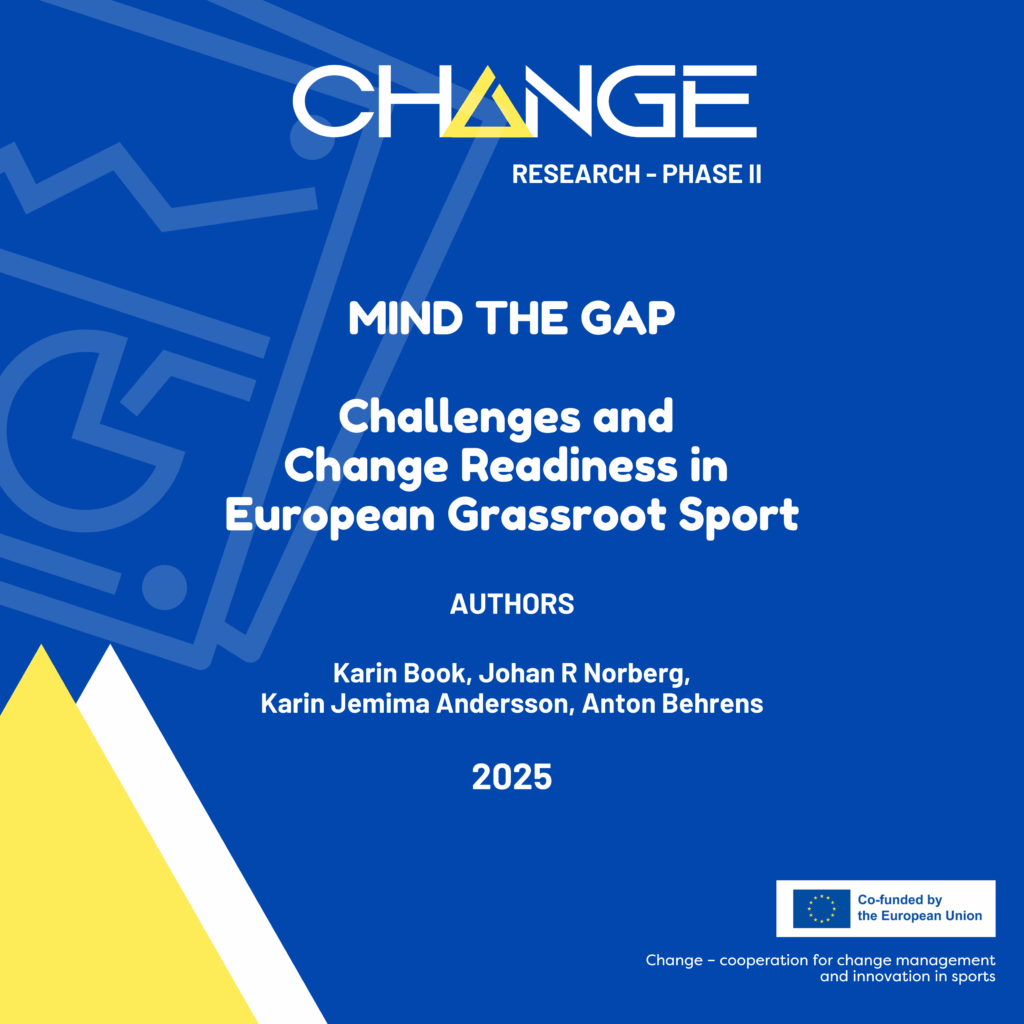
As part of the project, Malmö University’s Department of Sport Sciences and the European Association for Sport Management (EASM) carried out a wide-ranging study between 2023 and 2025. Their research combined literature reviews, surveys, workshops implemented by the partners, and case studies to understand how prepared grassroots sport is for change.
Here are some key takeaways:
- Innovation is unevenly distributed: Clubs with more resources, staff, and networks are more likely to experiment with new ideas, while smaller clubs struggle.
- Volunteers remain the backbone: Across Europe, clubs depend heavily on volunteer work. But with fewer young people joining and limited training, sustainability is at risk.
- Digitalisation isn’t a priority—yet: Despite its potential, many clubs reported low levels of readiness to adopt new digital tools.
- Leaders vs. local clubs: National federations often focus on big-picture societal goals, while local clubs are more concerned with day-to-day survival. This strategic–practical gap makes alignment difficult.
- Change requires ownership: Where leaders and members feel invested in change, resistance is lower and innovation is more successful.
Case studies from Bulltofta Sport Club in Sweden and Basics Sport Club in Belgium showed how innovative approaches—such as youth empowerment or structured volunteer collaboration—can create more resilient organisations. But even these success stories highlighted the need for long-term systemic support.
Bridging the gaps
The research identified several “gaps” that need attention if grassroots sport is to thrive:
- Expectation vs. reality – societal expectations of sport don’t always match what local clubs can realistically deliver.
- Strategic vs. practical – high-level strategies often feel far removed from local challenges.
- Willingness vs. resources – clubs are eager to innovate but lack time, money, and tools.
- Innovation vs. support – while new ideas exist, structural support is needed to make them sustainable.
To “mend the gap,” collaboration is essential. Governing bodies must not only encourage innovation but also provide concrete support aligned with the everyday realities of grassroots clubs.
Active agents or victims of circumstance?
A striking theme in the research was how sport representatives see themselves. Some view their organisations as “active agents”, capable of adapting and finding solutions. Others feel more like “victims of circumstances”, overwhelmed by external challenges like pandemics or societal shifts.
Most clubs fall somewhere in between, but the distinction matters. Building change readiness means helping clubs strengthen their confidence, capacities, and belief that they can shape their own future—rather than just respond to crises.
A spark for action: the #15MinOfCHANGE campaign
One of the most visible outcomes of the project is the #15MinOfCHANGE campaign. The idea is simple but powerful: every day, dedicate just 15 minutes to change.
Whether it’s rethinking how to recruit volunteers, trying out a new digital tool, starting a conversation about sustainability, or brainstorming ways to include more young people—small steps can make a big difference over time.
The campaign encourages clubs, federations, and individuals to treat change not as a daunting, large-scale overhaul, but as an ongoing, manageable process. By lowering the threshold for innovation, 15minofCHANGE helps grassroots sport move from awareness to action, showing that building resilience and adaptability is possible even with limited resources.
It is not just a slogan—it’s a practical call to action that reminds every organisation: you don’t have to change everything at once, but you do have to start somewhere.
What’s next?
The CHANGE project makes clear that bridging gaps in grassroots sport isn’t just a matter of communication—it may require rethinking how we view the role of sport in society. Should it be primarily about community wellbeing, professionalisation, or broader social policy goals? Perhaps all three, but clarity and alignment are essential.
Encouragingly, innovative practices are already emerging in clubs across Europe. By highlighting these success stories, launching initiatives like #15minofCHANGE, and ensuring that governing structures provide the right resources and frameworks, the CHANGE project is helping local sport organisations not just to survive, but to evolve.
As the researchers put it: it’s time to move from “Mind the gap!” to “Mend the gap!”
👉 What do you think? Could 15 minutes a day help your club or organisation take its next step toward change?