The Political Impact on Equality and Diversity Programmes in Grassroots Sport: ENGSO Hosts European Stakeholder Consultation
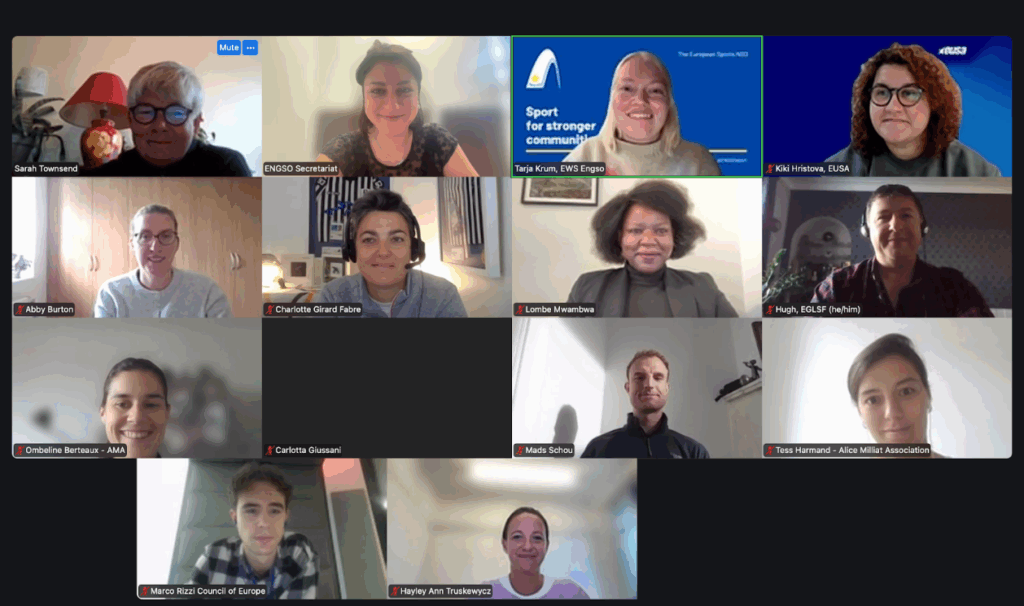
On 24 September, ENGSO EWS hosted and facilitated an online consultation with European stakeholders to explore emerging threats to gender equality and diversity in grassroots sport, in the context of current political developments across Europe and globally.
Participants underscored the need for integrated, cross-sector collaboration and deeper strategic reflection beyond immediate crises, emphasizing human rights and solidarity.
The discussion drew on findings from ENGSO EWS’s recent survey, The Political Pulse, which gathered input from 20 European and national sports organisations. While local and national groups reported more optimism about political support for equality and diversity than European-level bodies, funding cuts, especially affecting grassroots programmes for girls and women, were a major concern. Persistent challenges include limited progress on LGBTQ+ inclusion and cultural differences across regions. Respondents highlighted ENGSO’s vital role in providing resources, training, and guidance to support intersectional equality efforts.
To place the survey findings in a global context, the Global Observatory on Gender Equality and Sport presented on rising political interference in sport. Increasing censorship, the dismantling of research, and data loss are undermining gender equality efforts, driven by complex power dynamics. The Global Observatory urged cross-sector solidarity and action, framing political interference as a form of gender-based violence that endangers inclusive sport.
The European Gay and Lesbian Federation (EGLSF) stressed that today’s gender equality challenges in sport are long-standing issues reappearing in new forms, calling for focus on structural barriers over divisive debates. Exclusionary policies targeting trans and intersex athletes mirror past struggles. Research links LGBTIQ women’s sport involvement to income, with broader issues like funding and visibility often ignored. The EGLSF urges tackling longstanding barriers—like pay equity and safety—and promoting inclusive, rights-based approaches over polarized narratives.
Participating organisations agreed on the importance of resisting divisive political tactics that distract from broader equality goals and resource constraints. ENGSO EWS plans to use these insights and reflections to shape their next EWS webinar on 25. November, and future joint initiatives.
Participating organisations were the European Gay and Lesbian Federation (EGLSF), EPAS Council of Europe, the European Olympic Committee EU office, the European University Sport Association (EUSA) the Alice Miliat Association, the Global Observatory for Gender Equality and Sport, the International Federation for Sports Officials (IFSO), the International Working Group onWomen and Sport (IWG) and the Sport Unit of the European Commission.