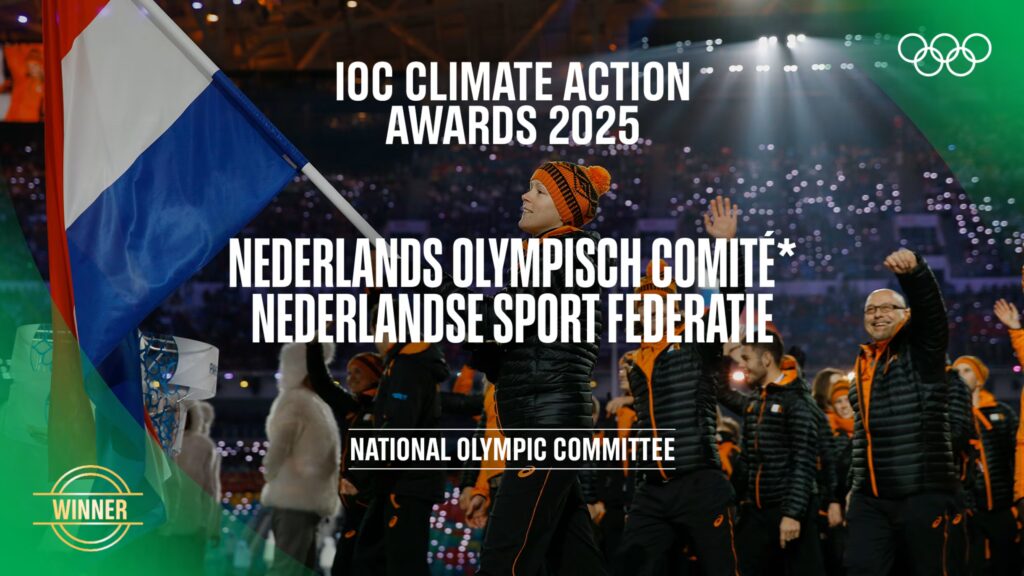
ENGSO member NOC*NSF among winners of IOC Climate Action Awards 2025
ENGSO Member, the National Olympic Committee of the Netherlands (NOC*NSF) has been named among the winners of the IOC Climate Action Awards 2025, as recently announced during the IOC Session in Milan, held ahead of the Milano Cortina 2026 Olympic Winter Games.
The IOC Climate Action Awards recognise impactful initiatives tackling climate change across the Olympic Movement.
NOC*NSF: leading the way in sustainable mobility and procurement
NOC*NSF has developed an integrated approach to sustainable mobility, reshaping how athletes and staff travel. After identifying that domestic travel accounted for nearly 70 per cent of its emissions, NOC*NSF launched a comprehensive strategy targeting the issue at its source. The approach combines electric vehicles, e-bikes and a digital mobility platform into one integrated system.
As a result, 65 per cent of Team NL’s fleet has already transitioned to electric vehicles, helping deliver a 40 per cent reduction in emissions. In addition, a dedicated mobility card and app — used by 850 athletes and 300 employees — integrates public transport, shared mobility and EV charging, promoting low-emission travel throughout the year.
Beyond mobility, NOC*NSF has also reduced emissions linked to procurement and equipment. For the Paris 2024 Olympic Games, the organisation shifted to more sustainable clothing options for participants’ kits, reducing related emissions from 206.7 tonnes of CO₂ at Tokyo 2020 to 60.9 tonnes in Paris — a cut of more than 70 per cent. Together, these procurement improvements and the wider mobility strategy set a strong benchmark for long-term, systemic impact in team operations.
Photo: IOC
NOC of Spain (COE) recognised as Highly Commended by the IOC
The Spanish Olympic Committee (COE) received a “Highly Commended” recognition for its structured and measurable approach to decarbonisation and governance.
Since 2018, the COE has reduced its emissions by nearly 28 per cent across all three scopes under the Greenhouse Gas Protocol — covering direct emissions, purchased energy and other indirect sources. This has been achieved through a strategy prioritising sustainable mobility, 100 per cent renewable electricity, solar panels, LED lighting and resource efficiency.
To extend its impact beyond its own operations, the COE also created the Sustainable Sports Seal — a certification system that integrates environmental, social and economic criteria into the management of sporting events and organisations.